Flat Roof Ponding Water & Ice Dam Leak Repair in Cleveland, OH
Emergency ponding water extraction, frozen scupper clearing, and seam reconstruction for low-slope TPO, EPDM, PVC, and Modified Bitumen roofs throughout Cuyahoga County.
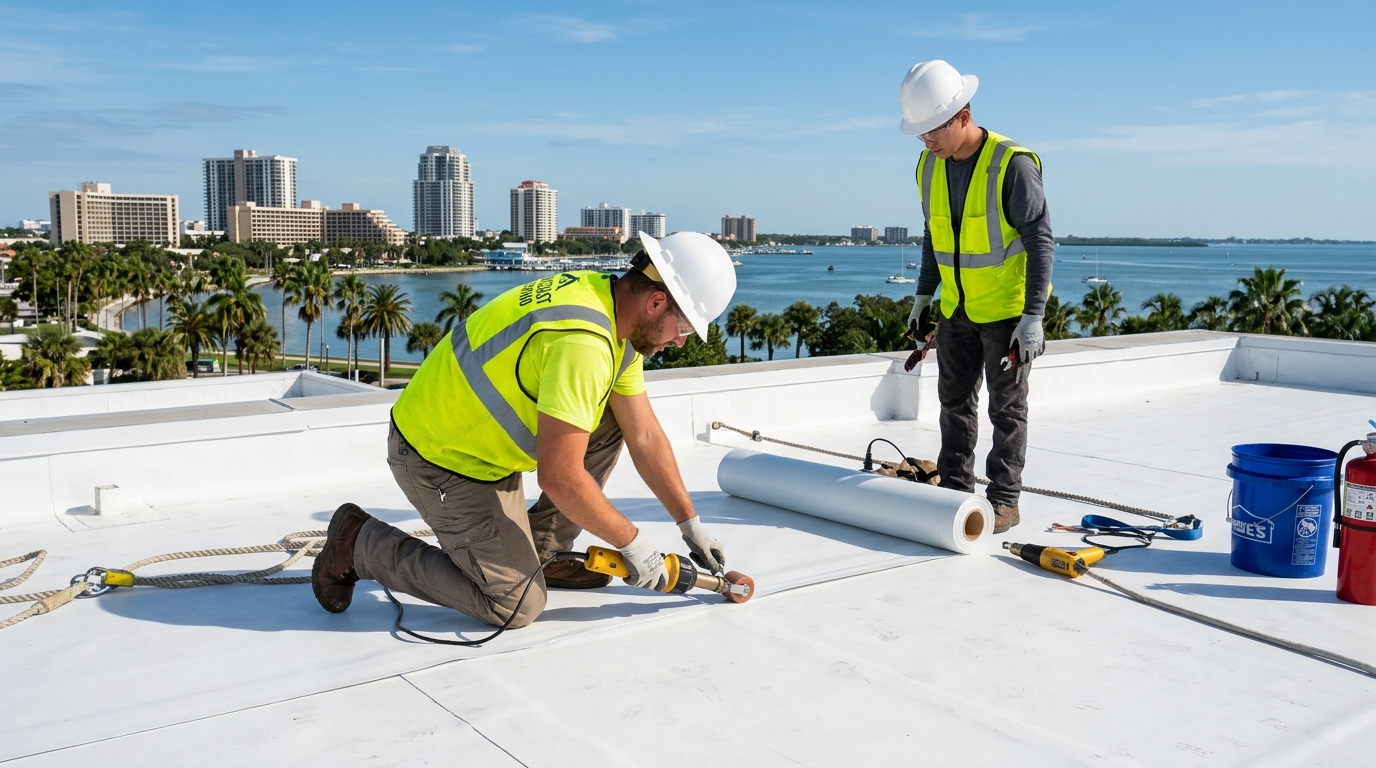
Immediate Cleveland Field Protocol: Flat Roof Ponding Repair
Root Engineering Challenge: Frozen drainage scuppers and structural deflection creating deep standing ice ponds that stress welded seams, rot insulation, and breach membrane perimeters.
- Step 1: Deployment of submersible extraction pumps to safely remove standing water and reduce structural dead loads
- Step 2: Thermal clearing of frozen internal drains, conductor heads, and through-wall scupper outlets
- Step 3: Robotic hot-air seam welding for TPO/PVC or dual-ply cold elastomeric adhesive application for EPDM/Mod-Bit
- Step 4: Perimeter parapet termination bar re-anchoring with commercial elastomeric sealants meeting ASTM C920
1. Lake Erie Regional Microclimate & Winter Storm Exposure
The climatic vulnerabilities of Cleveland, Ohio are directly shaped by its position on the southern shore of Lake Erie. During late autumn and winter months, Arctic air crossing the open, warm lake surface absorbs tremendous moisture, generating narrow, intense lake-effect snow squalls that deposit up to 30 to 45 inches of heavy, water-dense snow in a single weather system. As temperatures fluctuate between daytime thaws and sub-freezing night chills, this snowpack exerts immense physical stresses on residential and commercial roofing substrates.
In communities such as Lakewood, Parma, Westlake, and Strongsville, persistent freezing winds exceeding 50 to 65 mph strip shingles, freeze downspouts, and form massive eave ice dams. When meltwater backs up behind ice barriers or wind shear lifts perimeter metal flashings, water penetrates deep into roof assemblies. Understanding the specific metallurgical, thermal, and gravitational forces acting on your Cleveland roof is essential for selecting permanent, engineered restoration solutions rather than superficial temporary fixes.
2. Non-Destructive Moisture Diagnostics & FLIR Thermal Tracing
Water intrusion in multi-slope residential homes and low-slope commercial facilities rarely follows a straightforward vertical path. Water entering through a wind-torn ridge cap or an ice-dammed eave course frequently runs horizontally across plywood sheathing seams, along structural rafters, or over fiberglass insulation batts before penetrating interior drywall or plaster ceilings.
Dispatched contractors utilize high-resolution FLIR infrared thermal imaging cameras and digital capacitance moisture meters to track water intrusion non-destructively. Because wet building materials retain cooler temperatures through evaporative heat loss, infrared sensors map exact subsurface moisture boundaries as high-contrast color thermal gradients. This allows technicians to pinpoint the active entry point on the exterior roof deck without causing destructive damage to interior finished ceilings.
3. Step-by-Step Substrate Restoration Methodology
Permanent resolution of winter storm damage in Greater Cleveland demands strict adherence to engineered restoration protocols:
- Structural Assessment: Technicians inspect attic rafters, trusses, and plywood decking for delamination, dry rot, structural sagging, and microbial growth.
- Ice Dam Thermal Relieving: When active ice dams are present, dispatched crews deploy industrial low-pressure boiler steam (<100 PSI at 290°F) to carve vertical drainage slots without chipping shingles.
- Substrate Preparation: Damaged shingles, corroded valley metals, and brittle underlayment are stripped cleanly to expose sound decking. Rotted sheathing is replaced with APA-rated exterior CDX plywood.
- Multi-Layer Weatherproofing: Application of high-temperature self-adhering polymer-modified bitumen ice barrier membrane extending at least 24 inches inside the warm interior wall line, topped with synthetic tear-resistant underlayment.
- Mechanical Integration: Installation of ASTM D3462 dimensional architectural shingles fastened with hot-dipped galvanized roofing nails placed below sealant lines to withstand 130 mph Lake Erie wind gusts.
4. Ohio Building Code Title 4101:1 & Municipal Licensing Compliance
All roofing construction in Greater Cleveland must comply with the Ohio Residential Code (R905) and local municipal building ordinances enforced by the City of Cleveland Department of Building and Housing. Key technical requirements include:
- Ice Barrier Mandates: Ohio Residential Code R905.1.2 mandates self-adhering polymer-modified bitumen ice barriers along all eaves in Cuyahoga County due to historical freeze-thaw cycles.
- Wind Resistance Standards: Asphalt shingles must meet ASTM D3161 Class F or ASTM D7158 Class H wind uplift resistance ratings (tested up to 110–130 mph).
- Fastener Specifications: Minimum 11- or 12-gauge corrosion-resistant roofing nails with 3/8-inch diameter heads penetrating at least 3/4 inch into sound wood decking.
- Contractor Registration: Independent roofing contractors dispatched through our network maintain valid contractor registration with local municipal building departments, hold active commercial general liability coverage, and comply with Ohio Bureau of Workers' Compensation (BWC) standards.
5. Preventative Property Maintenance & Winter Storm Preparedness
Protecting your Cleveland property from catastrophic winter roofing failures requires proactive maintenance before winter storms strike:
- Attic Insulation & Air Sealing: Seal all thermal bypasses around can lights, plumbing stacks, and attic hatches. Maintain a minimum insulation level of R-49 to R-60 to keep attic deck temperatures below freezing.
- Gutter & Downspout Clearing: Remove all autumn leaves and organic debris from gutters and conductor heads prior to the first freeze to prevent water dams.
- Overhanging Tree Pruning: Trim mature oak, maple, and pine branches located within 10 feet of the roof to prevent mechanical abrasion and heavy snow-load branch snapping.
- Flashing Inspection: Schedule an annual inspection of chimney step flashings, pipe boots, and valley pans to reseal deteriorated mortar reglets before winter freeze-thaw cycles expand micro-cracks.
Facing Active Roof Damage in Greater Cleveland?
Zero web forms, callback queues, or email delays. Speak immediately with a live dispatch intake specialist to evaluate your emergency and mobilize on-call licensed local crews.
CLICK TO CALL DISPATCH: (888) 208-4155